
Presque Isle County Arrest Records and Court Charges
An arrest record is the log of an arrest itself. It notes who was taken into custody, which agency made the arrest, and the booking that follows at the Presque Isle County Jail on 2nd Street in Rogers City. The Sheriff's Office, led by Sheriff Joseph Brewbaker, runs that jail and keeps the incident and booking paperwork. An arrest alone does not prove guilt. It only starts the process. Soon after, the Presque Isle County Prosecuting Attorney reviews the case and decides whether to file formal charges. Once charges are authorized and filed with the court, they become the court charge record that the district or circuit court tracks.
The two records live in different places. The arrest and booking side sits with the Sheriff, and the jail roster and custody detail are covered on the county inmate records page. The court charge record is what the prosecutor filed and the court holds, showing each offense, its level, and its current status as the case moves. Court charges after arrest can be amended, reduced, or dropped long before any trial. The full case file, with pleas, verdicts, and sentences, is a broader record than the charge list alone.
How to Find Presque Isle County Arrest Records
There is no single database for Presque Isle County arrest records and charges. Different offices hold different pieces. Felony charges after bindover and divorce or major civil files start with the 53rd Circuit Court and the County Clerk. Misdemeanor, traffic, and preliminary felony charges start with the 89th District Court. The prosecutor's office decides which charges are filed. The Sheriff holds the arrest and booking paperwork. To read the court charge record online, the state judiciary offers MiCOURT Case Search for Presque Isle Circuit Court, which returns index and docket details rather than full document images.
- Decide which court holds the charge. Felonies after preliminary examination sit in the 53rd Circuit Court, while misdemeanors, traffic, and early felony complaints sit in the 89th District Court.
- Open the court case search for that court and enter the defendant name or the exact case number from any court paperwork you already have.
- Open the matching case and read the charge list, which names each offense and the statute cited against the defendant.
- Check every charge for its code, its severity level, and its current status, since one arrest can produce several charges that resolve in different ways.
The arrest and booking detail is a separate request. No public online jail roster was found for the county, so custody status is confirmed by calling the Sheriff's Office at 989-734-2156. A written incident or arrest report is available by mail: send the complaint or incident number, the date of the incident, a self-addressed stamped envelope, and $10 for a report or $20 for one over ten pages to the Presque Isle County Sheriff's Office, 267 N 2nd St., Rogers City, MI 49779, Attn: Records. The office may ask you to fill out a Michigan Freedom of Information Act request form for law-enforcement records.
How Charges Get Filed After a Presque Isle County Arrest
The charge record begins after the arrest, not during it. Once a person is booked, the Presque Isle County Prosecuting Attorney, Zakary McLennan, reviews the police request for a complaint or warrant. As the county's chief law enforcement official, the prosecutor authorizes and prosecutes felony and misdemeanor violations of Michigan law and county ordinances. If charges are approved, they are filed in a charging document. Michigan uses three main types. A complaint is the sworn accusation that opens most cases, and the 89th District Court issues both misdemeanor and felony complaints. After a felony is bound over to the 53rd Circuit Court, the prosecutor files an information. A grand jury indictment is rare in these northern counties but remains a lawful path for serious felonies.
| Complaint | Information | Indictment | |
|---|---|---|---|
| Filed By | Officer or prosecutor | Prosecuting Attorney | Grand jury |
| Common For | Misdemeanors and felony complaints | Felonies after bindover | Serious felonies (rare here) |
| Filed In | 89th District Court | 53rd Circuit Court | Circuit Court |
| Starts | The case | The felony case at circuit | The case |
Not every arrest leads to a charge. The prosecutor can decline to authorize a complaint, ask police for more investigation, or route a matter to a different track. When a felony complaint is filed, the district court arraigns the defendant, sets bond, and holds a preliminary examination to decide whether probable cause supports sending the felony up to the circuit court. That bindover is the point where the charge record shifts from the 89th District Court to the 53rd Circuit Court.
Presque Isle County Charge Status Explained
Charges rarely stay frozen. As a case moves, the prosecutor may amend a charge, reduce it, add a new count, or drop it. A plea deal can swap a felony for a lesser misdemeanor. A judge can dismiss a count for lack of evidence. The charge record shows the current status of each offense, so reading the status is as important as reading the charge name. The terms below appear often in Presque Isle County court files.
| Status | What It Means |
|---|---|
| Pending | The charge is filed and open, with the case still moving through arraignment, pretrial, or exam stages. |
| Amended / Reduced | The prosecutor changed the charge, often to a lower level, through a plea or a revised filing. |
| Dropped | The prosecutor withdrew the charge before it was resolved on the merits. |
| Dismissed | The court ended the charge, sometimes for weak evidence, a rights issue, or as part of a plea to another count. |
| Nolle Prosequi | A formal notice that the prosecutor will not pursue the charge further, closing it without a conviction. |
A dropped or dismissed charge still leaves a trace in the court index. It shows the charge was filed and then closed without a conviction. That is different from the offense never appearing at all. Anyone reading these records should note the final status before drawing conclusions about a person.
Charges vs. Convictions
Being charged is not the same as being convicted. A charge is an accusation that the state must still prove. A conviction is the result, reached by a guilty plea or a verdict. Many charges in Presque Isle County are reduced or dismissed and never become convictions. The full outcome, with the plea, verdict, and sentence, lives in the criminal court records for the case, not in the charge line alone.
| Charge | Conviction | |
|---|---|---|
| Stage | Accusation filed | Verdict or guilty plea |
| Burden of Proof | Probable cause | Beyond a reasonable doubt |
| Meaning | Not proof of guilt | Finding of guilt |
| Public Record | Yes | Yes, unless set aside |
Sealed vs. Expunged Records
Michigan handles cleared records through a process called a set-aside, sometimes described as expungement. Under MCL 780.621, eligible adult convictions can be set aside so they leave ordinary public view. The state's Clean Slate laws now include both application-based set-asides and automatic relief for some convictions. A set-aside record is not destroyed. As MCL 780.623 explains, it stays available to law enforcement, courts, and certain agencies even after it leaves public search.
| Sealed | Set Aside / Expunged | |
|---|---|---|
| Visibility | Hidden from public view | Removed from ordinary public access |
| Record Kept | Not destroyed | Not destroyed, made nonpublic |
| Law Enforcement | Limited access | Still available to police and courts |
| Eligibility | By statute or court order | Eligible adult convictions under Clean Slate |
Anyone seeking a set-aside should start with the court that entered the conviction. Felonies point back to the 53rd Circuit Court, while misdemeanors and many traffic misdemeanors point to the 89th District Court. The right forms come from the state courts, and eligibility rules are detailed, so this is a matter for the court and, where needed, an attorney.
Presque Isle County Charge Codes and Severity Levels
Each charge in a Presque Isle County court file ties to a specific Michigan statute or county ordinance. The record lists the offense name, the citation, and the level. Level matters because it sets the court, the penalties, and the path a case takes. Michigan sorts most offenses into three broad tiers.
- Felonies carry the most serious penalties. They start with a complaint at the 89th District Court, then bind over to the 53rd Circuit Court for trial and sentencing.
- Misdemeanors carry a maximum penalty of one year or less and stay in the district court, which arraigns, tries, and sentences these cases.
- Civil infractions, such as many traffic tickets, are not crimes at all. They are handled in the district court's traffic and civil divisions.
One arrest can generate several separate charges at once. A single incident might produce a felony count, a companion misdemeanor, and a civil infraction, each with its own code, level, and status. Reading each charge line by line is the only reliable way to understand what the record actually shows.
Statewide Charge and Criminal History Lookups
Charges filed in Presque Isle County also roll up into statewide systems. The Michigan State Police runs the Internet Criminal History Access Tool, known as ICHAT, which returns public criminal-history conviction records for a fee. ICHAT is a useful summary, but it is not the same as the local court file, and it does not include warrant information. For a certified or complete record, the court that holds the case is still the source.
A separate statewide channel is the Michigan Sex Offender Registry, a public safety tool that lists people required to register after certain convictions. Its search page is maintained by the Michigan State Police at the Michigan Sex Offender Registry site.
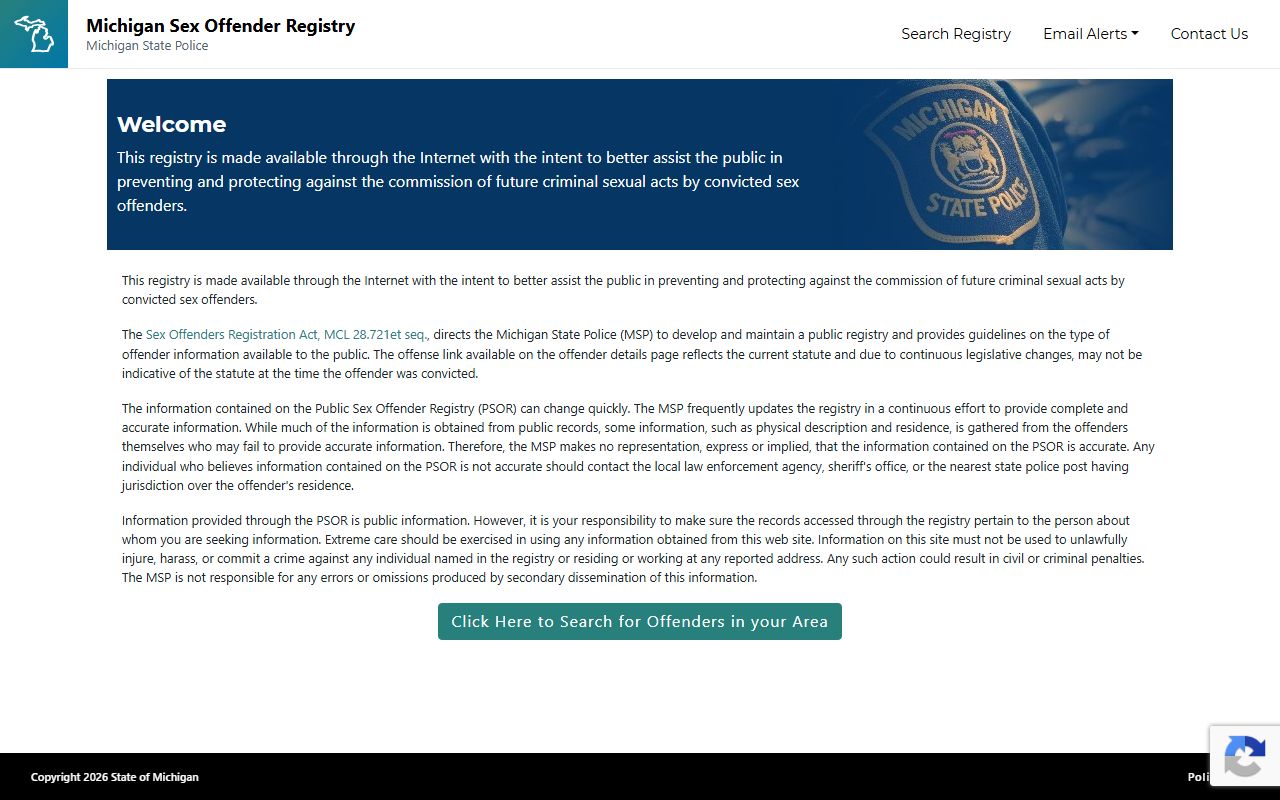
The registry lets residents search by name or by area to see registered offenders, the offense of record, and location details. It reflects the outcome of past charges, not open cases, so it works alongside the court charge record rather than replacing it.
The Michigan State Police also publishes background material that explains how the registry works, who must register, and what the public listing includes, on its sex offender registry information page.
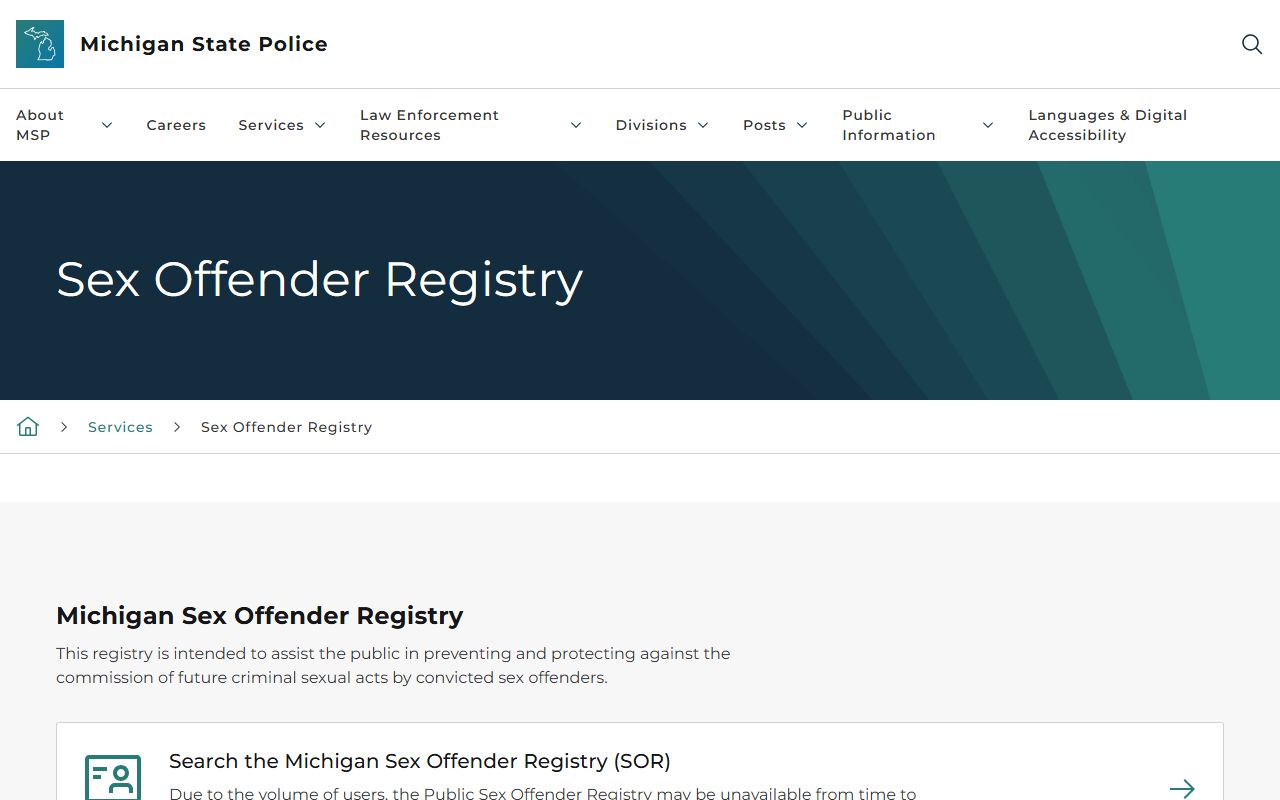
That guidance helps readers understand the limits of the registry as a charge tool. It shows registered status tied to convictions, so a charge that was dropped, dismissed, or reduced would not appear there. For active charges in the county, the district and circuit court records remain the primary source.
Background Checks on Presque Isle County Records
People look up charge records for many reasons, from personal curiosity to checking a name before a private deal. A casual lookup through ICHAT or a court index is fine for general information. A formal background check for hiring, housing, credit, or insurance is different. Those uses fall under the federal Fair Credit Reporting Act and must run through a properly regulated consumer reporting agency that follows its rules. The county court index and statewide tools are not designed for that regulated purpose.
Important: This website is not a consumer reporting agency under the Fair Credit Reporting Act, and its information may not be used for employment, tenant, credit, or insurance screening.
Restricted Charge Records in Presque Isle County
Not every charge is open to the public. Michigan law walls off several categories, and the Presque Isle County courts follow those limits. Juvenile charges are among the most tightly held. Under MCL 712A.28, many records of youth under 17 who violate state law are confidential, and the prosecutor reviews those petitions through the Family Division rather than the open adult docket.
Other records are limited too. Set-aside convictions leave public view under Michigan's Clean Slate laws. Sealed matters, adoption and child-protection files, and mental-health proceedings are closed by statute or court order. Search warrants and sealed investigations may stay private until they are executed and returned. Michigan court rules, including MCR 8.119, also bar courts from posting document images online, so full charging papers usually require a request to the clerk. Personal identifiers such as Social Security numbers are redacted from public files.
Note: When an online search shows little or nothing, the charge may be restricted, and the district or circuit court clerk is the office to contact for a certified copy.