
Criminal Court Records in Presque Isle County
A criminal court record is the official file a court opens the moment charges are filed against a named defendant. In Presque Isle County the file is built and held by the court clerk for the court hearing the case, and it grows with every document and event until the matter closes. It holds the charging papers, the bond record, the plea, each motion and order, the verdict or plea outcome, and the sentence. The 89th District Court keeps the criminal clerk file for its own cases, while felony files that move up are kept by the County Clerk acting as clerk of the 53rd Circuit Court. Michigan court rules treat these files as public records, part of the wider body of Presque Isle County court records the courts maintain, but the paper images behind the index are not posted online.
Two trial courts share the criminal workload in the county, and both also serve neighboring Cheboygan County. The 89th District Court handles misdemeanors with a maximum penalty of one year or less, arraigns defendants, sets and accepts bond, and holds the preliminary examination in felony cases. Serious felonies move to the 53rd Circuit Court after the district stage for arraignment on the information, trial, and sentencing. The Prosecuting Attorney, Zakary McLennan, reviews and authorizes the charges that open each case, so the record reflects a charging decision as much as an arrest.
How to Search Presque Isle County Criminal Court Records
Most Presque Isle County criminal case lookups start with the state judiciary's online tools. The 53rd Circuit Court publishes felony case data through MiCOURT Case Search, and the county's court pages link the district and probate case tools alongside it. These systems return index and docket information, such as the case number, parties, charges, hearing dates, and disposition, but not the scanned documents themselves.
The county's 89th District Court page describes the criminal, civil, and traffic divisions and names the clerks who manage each case file.
That district court is the front door for misdemeanor cases and the first stop for every felony complaint before it reaches the circuit level. Working the search in a set order keeps the results clean.
- Open MiCOURT Case Search for the 53rd Circuit Court, or the county's district-court case link for misdemeanor and traffic matters.
- Search by the defendant's name, or enter the case number directly when court papers list it.
- Narrow the results by court, case type, and filing date to reach the right file.
- Open the case to read the docket entries, charges, plea, and final disposition.
- Request a certified copy from the 89th District Court criminal clerk or the County Clerk when a paper record is needed.
For a statewide picture, the Michigan State Police ICHAT service returns a name-based criminal-history summary drawn from felony and serious-misdemeanor convictions across the state. It is a useful cross-check, yet it is not the county court file and it does not list warrants. Older Presque Isle County files that predate the digital systems may exist only on paper and need an in-person or mail request to the clerk.
Stages of a Presque Isle County Criminal Case
A criminal case leaves a trail of dated entries as it moves through the courts, and each stage adds its own layer to the record. In Presque Isle County a felony usually begins in the 89th District Court and, if the evidence supports it, binds over to the 53rd Circuit Court for the remaining stages. A misdemeanor generally stays in district court from start to finish. Reading the entries in order shows exactly where a case stands.
Case flow: Charges Filed › Arraignment › Preliminary Exam / Bindover › Pretrial / Motions › Plea or Trial › Disposition › Sentencing
The Presque Isle County Prosecuting Attorney reviews complaint and warrant requests and authorizes the charges that formally open a case.
Because the prosecutor decides what is filed, the charges recorded in the file can differ from the offense listed on the original arrest.
| Stage | What Happens |
|---|---|
| Charges Filed | The prosecutor reviews the complaint and authorizes charges, which opens the court file and assigns a case number. |
| Arraignment | The defendant hears the charges and rights, enters an initial plea, and the court sets bond and release conditions. |
| Preliminary Exam / Bindover | In felony cases the district court weighs whether probable cause supports sending the case up to circuit court. |
| Pretrial / Motions | Attorneys exchange evidence, argue motions, and discuss a possible plea before any trial. |
| Plea or Trial | The case ends in a plea, or a judge or jury decides guilt at trial. |
| Sentencing | After a conviction the court imposes the penalty, which may include jail, probation, fines, costs, or restitution. |
What a Presque Isle County Criminal Court Record Shows
A Presque Isle County criminal court record is built around a set of standard fields that stay consistent from case to case. The docket lists every event by date, while summary fields capture who was charged, with what, and how the matter ended. Michigan files also carry a Criminal Tracking Number, or CTN, that links the court case to statewide criminal-history data. Financial fields track any fines, costs, restitution, and bond tied to the case.
| Field | What It Shows |
|---|---|
| Case Number | The court's official identifier for the file, formatted exactly as the court papers or MiCOURT show it. |
| Defendant | The accused person's name, with protected identifiers such as Social Security numbers redacted. |
| Charges | Each offense as filed, with its statute citation and severity level as a misdemeanor or felony. |
| Plea | The defendant's formal answer to the charges, such as guilty, not guilty, or no contest. |
| Disposition | The outcome of each charge, such as dismissed, a plea, a verdict, or a sentence entered. |
| Sentence | The penalty imposed after a conviction, including jail, probation, fines, costs, or restitution. |
Charges vs. Convictions in Presque Isle County
Being charged is not the same as being convicted, and a criminal court record makes the difference plain. A charge is an accusation the prosecutor files based on probable cause. A conviction requires proof beyond a reasonable doubt, reached by a plea or a verdict. A county file can show charges that were later dropped, dismissed, reduced, or ended in acquittal, and each of those outcomes stays visible in the record. A closer look at how a charge is filed, coded, and amended appears in the county's arrest records and court charges.
| Charge | Conviction | |
|---|---|---|
| Stage | Accusation | Verdict or plea |
| Burden of Proof | Probable cause | Beyond a reasonable doubt |
| Meaning | Not proof of guilt | Legal finding of guilt |
| Public Record | Yes | Yes |
Reading Dispositions and Sentences
The disposition is the single most important line in a criminal record because it states how the case ended. Common Presque Isle County dispositions include guilty and not-guilty findings, dismissals, no-contest pleas, and cases resolved through a plea agreement to reduced charges. Some cases carry a deferred or delayed status, where a plea is held open while the defendant completes conditions, and the outcome depends on whether those conditions are met. Reading the sentence next to the disposition gives the full result. A guilty disposition may carry jail time, probation, fines and costs, restitution to a victim, or a mix of these. Probation places a person under court supervision in the community, while longer prison terms are served through the Michigan Department of Corrections rather than the county jail.
ICHAT vs the Presque Isle County Court File
Residents often confuse the statewide criminal-history summary with the county court file, but they are two different records. The Michigan State Police maintain ICHAT, the Internet Criminal History Access Tool, which returns a name-based history of felony and serious-misdemeanor convictions from across Michigan. The county court file, by contrast, holds the full docket for a single case, including charges that never became convictions.
The Michigan State Police criminal-history records page explains what an ICHAT search covers and what it leaves out.
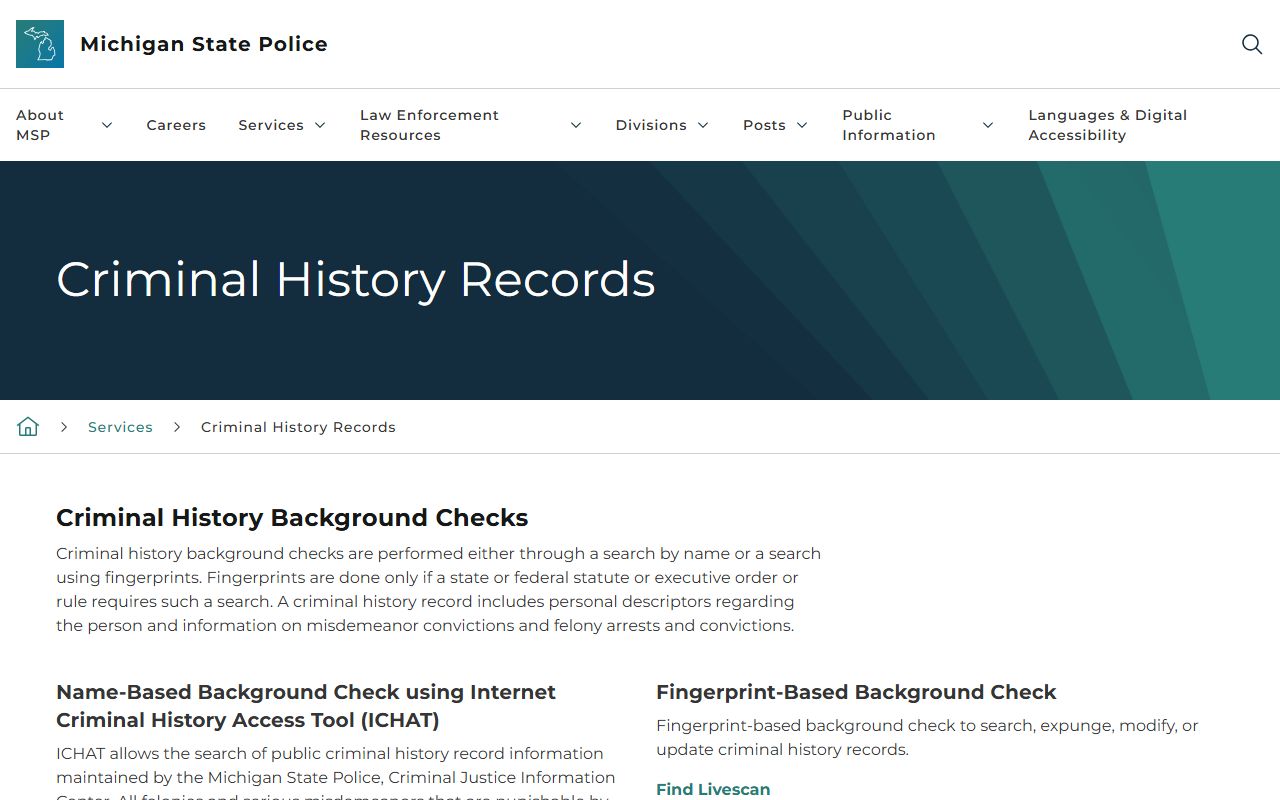
ICHAT does not include warrant information, so a clear ICHAT report is not proof that a person has no pending case or open warrant in the county. Active warrants are tracked separately by the courts and sheriff.
Sealed vs. Expunged Criminal Records
Michigan's Clean Slate laws let eligible people limit public access to old convictions, and the criminal record shows the result. A set-aside, the state's term for expungement, does not physically destroy the file. Under state law the conviction is removed from ordinary public view but stays available to courts, law enforcement, and certain agencies. Some convictions now clear automatically, while others require an application to the court that entered the conviction.
Michigan's set-aside statute at MCL 780.621 sets out which adult convictions can be cleared and how.
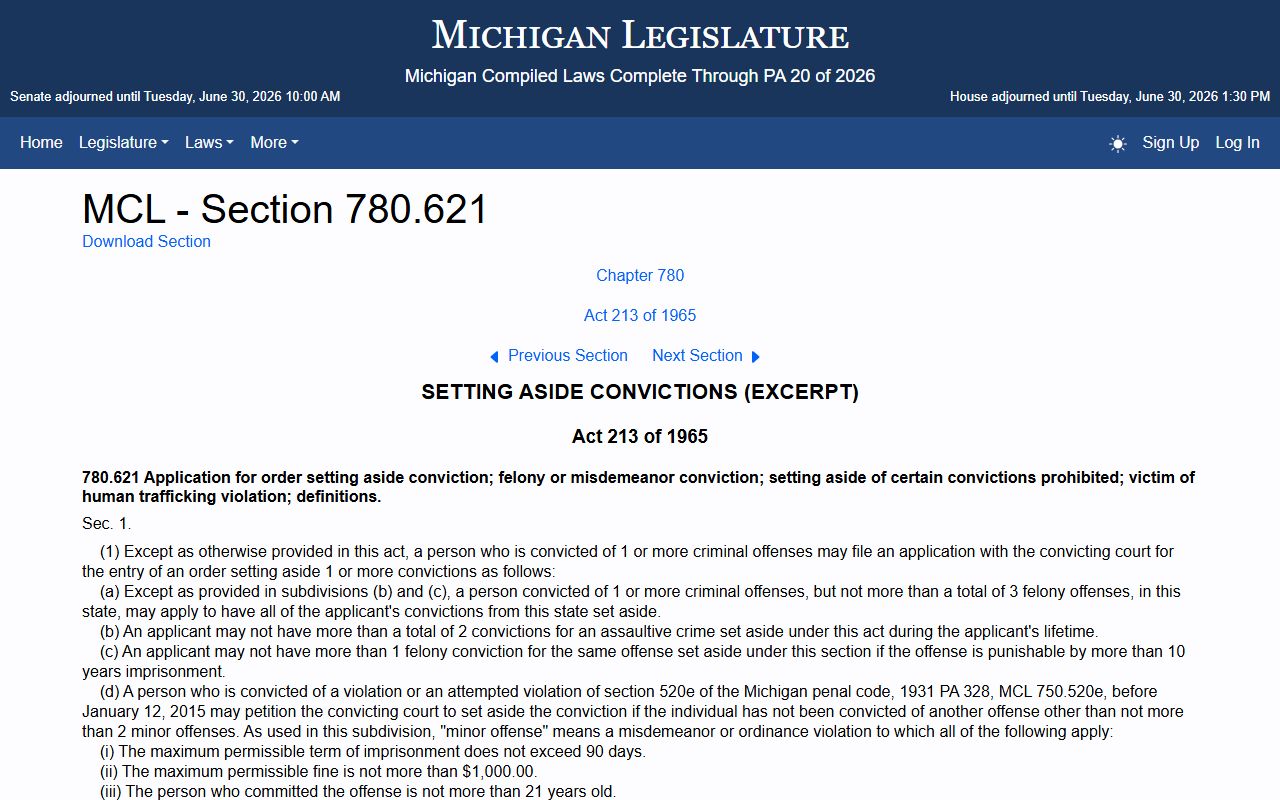
Felony set-asides usually run through the 53rd Circuit Court, while misdemeanor convictions are handled by the 89th District Court that entered them.
| Sealed | Expunged / Set Aside | |
|---|---|---|
| Visibility | Closed to the public by court order | Removed from public view, treated as nonpublic |
| Law Enforcement | Limited access | Courts, police, and named agencies keep access |
| Record Kept | File preserved but closed | File retained, not destroyed |
| Eligibility | By statute or court order | Eligible convictions under Michigan Clean Slate law |
Public Access to Presque Isle County Criminal Records
Criminal case files in Presque Isle County are open because Michigan law favors public court records. The Freedom of Information Act governs records held by public bodies, while court files follow the judiciary's own rules for access and copies. Michigan Court Rule 8.119 sets how courts maintain and share their records, and it is the reason the online index shows case data but not scanned document images.
Key Statutes:
Michigan FOIA, MCL 15.231 - Public bodies must give access to public records unless a specific exemption applies.
FOIA procedures, MCL 15.235 - Sets how to file a written request and how the office must respond, deny, or note fees.
Background Check Considerations
A casual name search and a formal background check are not the same thing. Employers, landlords, and licensing bodies that make decisions under the federal Fair Credit Reporting Act must use a regulated consumer reporting agency and follow its notice and consent rules. Court index results and statewide ICHAT summaries are fine for personal knowledge, but they can be incomplete, and set-aside convictions will not appear. Anyone relying on a criminal record for a formal decision should verify it against the certified file from the court that entered it.
Important: This website is not a consumer reporting agency under the Fair Credit Reporting Act, and its records may not be used for employment, tenant, or credit screening.
Restricted Criminal Court Records in Presque Isle County
Not every criminal matter is open to public browsing. Juvenile cases, handled through the circuit court's Family Division, are confidential under Michigan's juvenile code at MCL 712A.28, so those files are not part of a general public search. Sealed and set-aside convictions drop out of ordinary public view, and mental-health commitment records held by the Probate Court stay closed. Court staff also withhold protected personal identifiers, and some entries in an active case may be redacted while the matter is pending.
The set-aside effect statute at MCL 780.623 explains that a cleared record is kept rather than destroyed and stays available to authorized users.
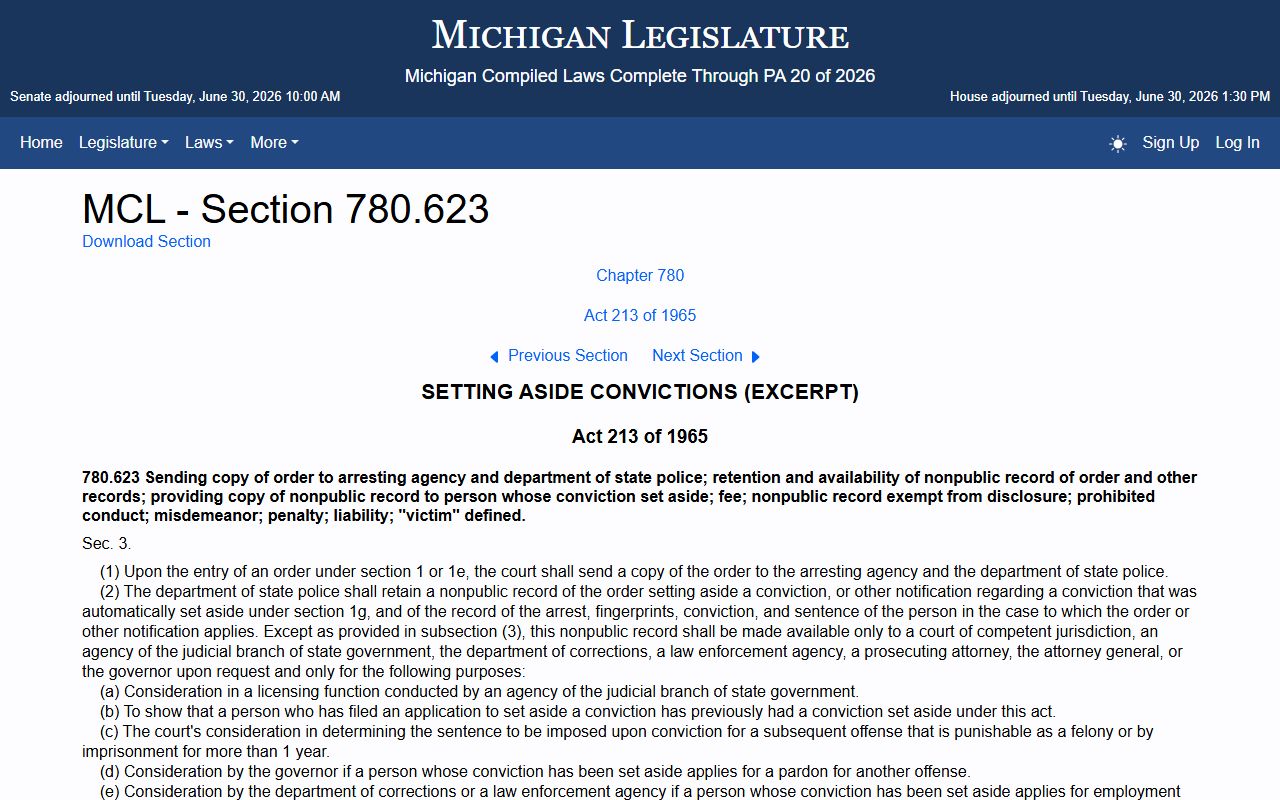
That balance keeps a set-aside meaningful for the public while preserving the file for the courts and police who are allowed to see it.