
What Probate Covers in Presque Isle County
The Presque Isle County Probate Court is the local court for matters that follow a death or a loss of legal capacity. Its work centers on the admission of wills, the administration of estates and trusts, the treatment of people who are mentally ill, guardianships, and conservatorships for minors, adults, and adults who are developmentally disabled. Many further areas of probate authority are set by Michigan statute, so the court's reach is broader than any short list can show.
One judge leads the court. Chief Judge of Probate Kimberly Gildner holds a six-year term that runs from 2025 to 2030. Probate Register Jennifer Warwick and Deputy Register Jen Palmer manage the filings, the case index, and copy requests at the counter. Unlike the 53rd Circuit Court and the 89th District Court, which each serve both Presque Isle and Cheboygan Counties, the Probate Court sits as a local venue with its own judge and register. The same judge also serves as the county's Family Court judge, so estate work and family work share one bench.
Every probate matter opens with a petition or an application and ends only when the court signs a closing order.
Probate Terms Defined
Probate paperwork carries words that rarely appear in daily life. A short guide helps before you read a petition, an inventory, or a court order, since one term can decide who has authority over an estate or a person.
- Testator
- The person who made the will. A valid will speaks for the testator after death.
- Executor
- The person named in a will to carry out its terms. In Michigan the court often calls this role a personal representative.
- Intestate
- Dying without a valid will. State law then decides who inherits.
- Guardianship
- A court arrangement that gives one person authority over the personal care and decisions of a minor or an incapacitated adult.
- Conservatorship
- A court arrangement that gives one person authority over the money and property of a minor, an adult, or a developmentally disabled adult.
- Fiduciary
- Anyone the court appoints to act for another, such as a personal representative, guardian, conservator, or trustee, held to a duty of good faith.
- Ward
- The minor or protected person for whom a guardian or conservator has been appointed.
How Probate Works in Presque Isle County
A probate matter moves through set stages, and an estate follows the fullest version of that path. Knowing the order helps you time a filing and predict which document comes next. The steps below trace a typical estate from the first application to the closing order.
- Identify the matter type: estate, will admission, trust issue, guardianship, conservatorship, mental-health treatment, or a related family assignment.
- Obtain the correct Michigan Courts form and file it with the Presque Isle Probate Court at 151 East Huron Avenue, or by mail to P.O. Box 110, Rogers City.
- Petition or apply to open the case. The court and register review the filing for requirements, fees, notice, and any hearing.
- Appointment of a fiduciary. The judge names a personal representative for an estate, or a guardian or conservator for a protected person, and issues letters of authority.
- Bond where required. The fiduciary may post a bond that protects the estate or the ward against loss.
- Inventory. The fiduciary lists the assets and their values on the court's inventory form.
- Notice and accounting. Interested persons and creditors receive notice, and the fiduciary files accountings that show money in and money out.
- Distribution and closing. Property passes to heirs or beneficiaries, and the court signs an order that closes the case.
Note: Guardianship and conservatorship cases add evaluations, appointment orders, and periodic reports, and some protected-person detail stays out of public view.
How to Search Presque Isle County Probate Records
No single database holds the full text of Presque Isle County probate files. The court offers a public hearing calendar, a set of state forms, and counter service, and older or complete files come from the Probate Register. The MiCOURT Court Display calendar is the main online tool. It shows the day's scheduled hearings for the Presque Isle Probate Court and lets you step back and forth by date.
The official Presque Isle County Probate Court page carries the phone, fax, email, judge and staff names, and the calendar and forms links used to reach a file.
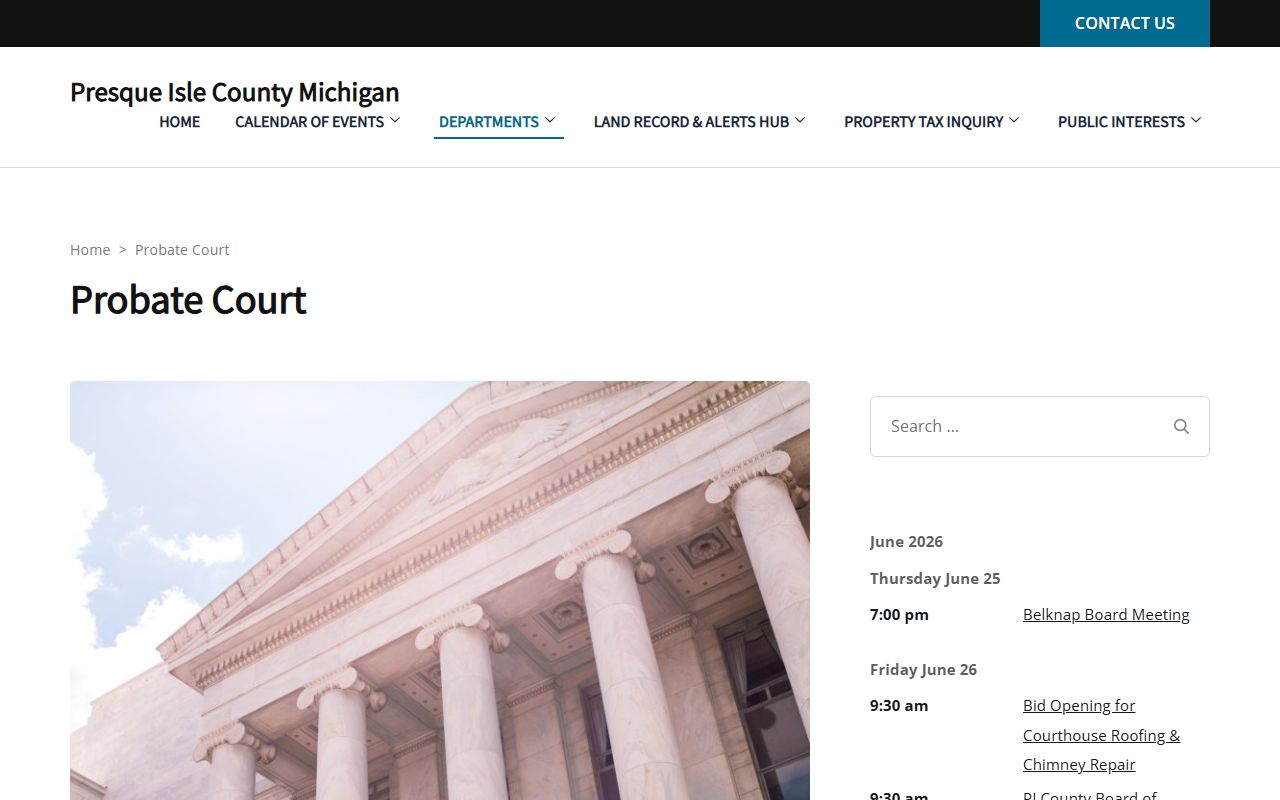
That page is the safest starting point, because it routes every request to the register who actually holds the record. Several channels reach the same court.
- Online calendar: the MiCOURT Court Display for daily probate hearing schedules.
- Forms: the Michigan Courts forms library and the specific probate forms linked from the court page.
- Phone and email: 989-734-3268 and piprobate@picounty.org.
- In person: the Probate Court counter at 151 East Huron Avenue, Rogers City.
- Copies and older files: a request to the Probate Register, who keeps the case index and the paper files.
The Court Display calendar for the Presque Isle Probate Court is built to review schedules, not to pull certified files. It opens on a request date, loads a table of public hearing events for that day, and offers simple day controls. The fields below show what the public calendar accepts and returns.
| Field Label | Type | Required | Options / Format Notes |
|---|---|---|---|
| Request Date | Date input | Yes | Sets the day whose hearings load in the table |
| Yesterday | Arrow link | No | Moves the calendar one day back |
| Today | Button | No | Restores the current date |
| Tomorrow | Arrow link | No | Moves the calendar one day forward |
| Public events table | Dynamic table | n/a | Displays hearing and event rows for the selected date |
Presque Isle County Probate Court Contact
Probate work is handled at the county building in Rogers City, the county seat. The Probate Court and its Family Division share the same address, and both use the same email inbox, so a call or message reaches staff for either side of the bench.
Presque Isle County Probate Court
151 East Huron Avenue, P.O. Box 110
Rogers City, MI 49779
989-734-3268
Fax: 989-734-4420
piprobate@picounty.org
Mon to Fri, 8:00 a.m. to 4:30 p.m.
Family Division
151 East Huron Avenue
Rogers City, MI 49779
989-734-2214
piprobate@picounty.org
Mon to Fri, 8:00 a.m. to 4:30 p.m.
The county lists direct emails for its offices, which helps rural residents confirm a record before a long drive. Presque Isle County spreads across townships from the Lake Huron shore to inland Onaway, Posen, and Millersburg, so a phone or email check often saves a trip to Rogers City for a file that is closed or held elsewhere.
Probate Forms for Presque Isle County Estates
Michigan runs a single statewide forms library, and the Probate Court page links straight to it. Using the state form for your matter keeps the filing in the format the court expects, which speeds review at the counter and by the register.
The Michigan Courts forms site groups probate forms by subject and offers them as fillable documents.
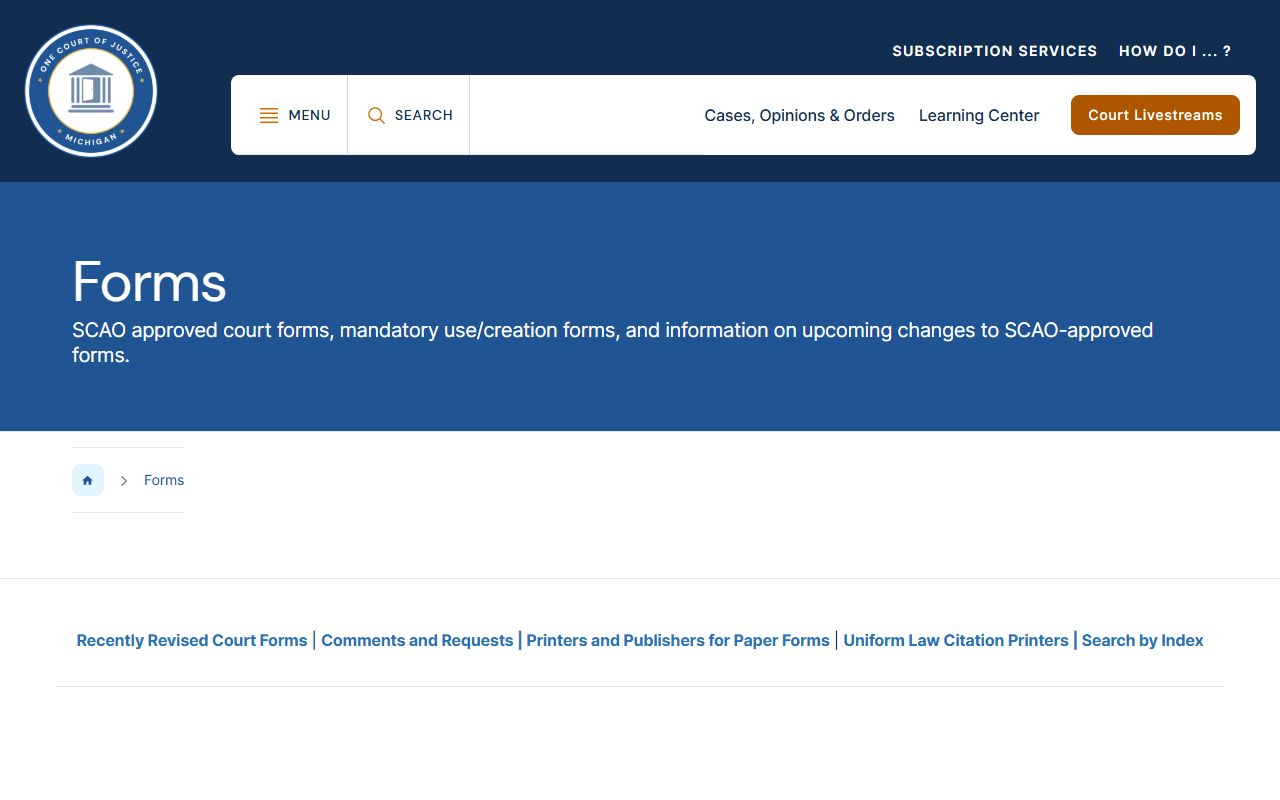
From that library the Presque Isle Probate Court points filers to the exact forms an estate or a protective case needs. The forms named on the court page include the following.
- Acceptance of Appointment, signed by a fiduciary who agrees to serve.
- Appearance of Parent of Minor, filed in cases that involve a minor.
- Bond of Fiduciary, used when the court requires a bond.
- Inventory, listing the estate assets and their values.
- Inventory (Conservatorship), the version for a protected person's assets.
- Estates, Trusts, and Miscellaneous Probate Forms, the broad set for general filings.
Presque Isle County Probate Court Fees
Filing and copy fees are set by statute and by the court, not by any figure this resource could confirm for Presque Isle County. The inspected county probate pages did not publish a local fee schedule, so exact dollar amounts should come straight from the court rather than from an outside estimate.
Call the Probate Court at 989-734-3268 before you file or request a copy, and ask for the current fee for your form or for a certified copy. The Michigan Courts forms library also flags fee-related instructions on many probate forms. Fees can differ for an estate application, letters of authority, a certified copy, or a guardianship petition, so confirm the figure for your exact document.
Certified copies carry a separate charge from plain copies, and only a certified copy is accepted for banks, title transfers, and other legal proceedings.
What Presque Isle County Probate Records Show
An open probate file gathers the documents that move an estate or a protective case from start to finish. For an estate, that means the will if one exists, the petition or application, the letters of authority, the inventory of assets, notices to heirs and creditors, accountings, and the final order of distribution. For a guardianship or conservatorship, the file holds the petition, evaluations or medical information where the court requires them, the appointment order, inventories, accountings, and periodic reports on the ward or protected person.
The public hearing calendar shows far less. It lists the date, the court, and the scheduled event rather than the contents of any document. To read a will, an inventory, or an order in full, you request the file or a certified copy from the Probate Register. The County Clerk, who serves as Clerk of the Court for circuit matters, is a separate office, so a probate copy request goes to the Probate Court rather than the clerk's vital-record counter.
Family Court and Presque Isle County Probate
The Presque Isle Probate Court reaches beyond estates because the probate judge also sits as the county's Family Court judge. This one-judge design means a single bench handles the family matters that often travel together for one household. The court hears juvenile delinquency, child abuse and neglect, name changes, adoptions, and emancipation proceedings.
It also works alongside the circuit bench on divorce, custody, and paternity cases that overlap with the juvenile caseload, which are tracked with the county's marriage and divorce records. Handling all family issues for one family under one judge keeps related cases consistent and helps the court avoid conflicting orders. It also explains why a probate contact can answer questions that reach into adoption or juvenile territory.
Restricted Presque Isle County Probate Records
Some of the most sensitive files in the courthouse sit in probate. Mental-health treatment cases and protected-person details are closed to general public browsing, and minor guardianship and adoption records carry added protection. Personal identifiers such as Social Security numbers, financial-account numbers, and protected addresses are redacted or withheld even when a file is otherwise open.
Michigan's juvenile code sets much of this confidentiality, and the statute at MCL 712A.28 spells out how far public access reaches into juvenile matters.
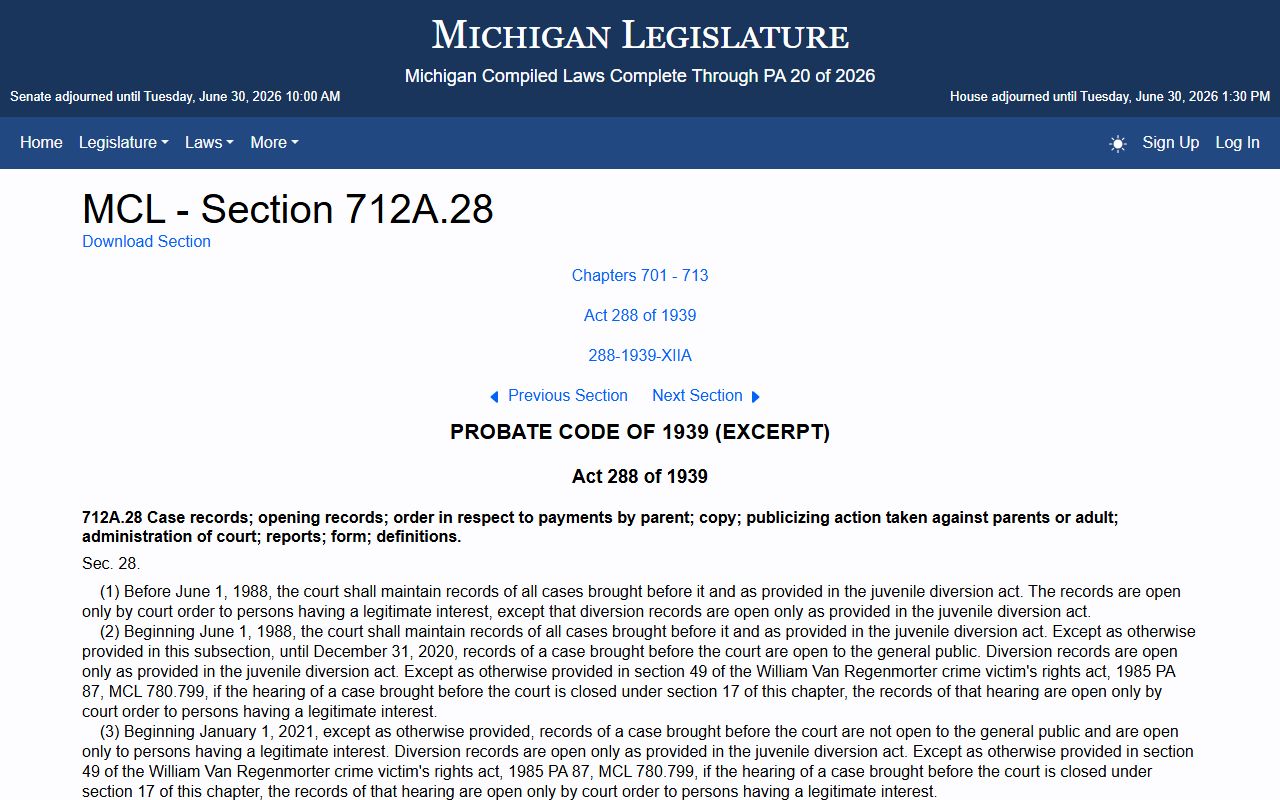
Because the probate judge also handles juvenile cases, that same confidentiality shapes what the counter can release. For a restricted file, expect the register to ask for proof of identity, party or attorney status, or a court order before releasing anything. Open records such as the hearing calendar and the general case index stay available to anyone, while sealed estates, guardianship medical detail, and juvenile or adoption records do not.
Note: When you are unsure whether a probate file is open, call the Probate Register first so you do not travel to Rogers City for a record that stays closed.